
The booking channel alone does not determine the cost of a Greek yacht charter. In a Moorings crewed yacht charter vs. boutique Greek sailing agencies comparison, the owner’s weekly yacht rate is the same regardless of which company sends the booking, with the broker’s commission paid from the owner’s side. The yacht, season, included services and additional expenses shape the overall budget.
It is easy to focus on the headline rate and overlook what the charter includes. Here, you’ll learn what to compare in a crewed charter, how booking options shape the experience and which extra costs to consider, from provisioning and mooring to onboard expenses.
We’ll also explore how large fleet operators differ from boutique agencies, so you can compare equivalent offers and choose an arrangement suited to your itinerary, comfort and time at sea.
Key Takeaways
- Compare crewed charters by the services included, not just the headline rate. Crew, onboard support and trip details shape the experience.
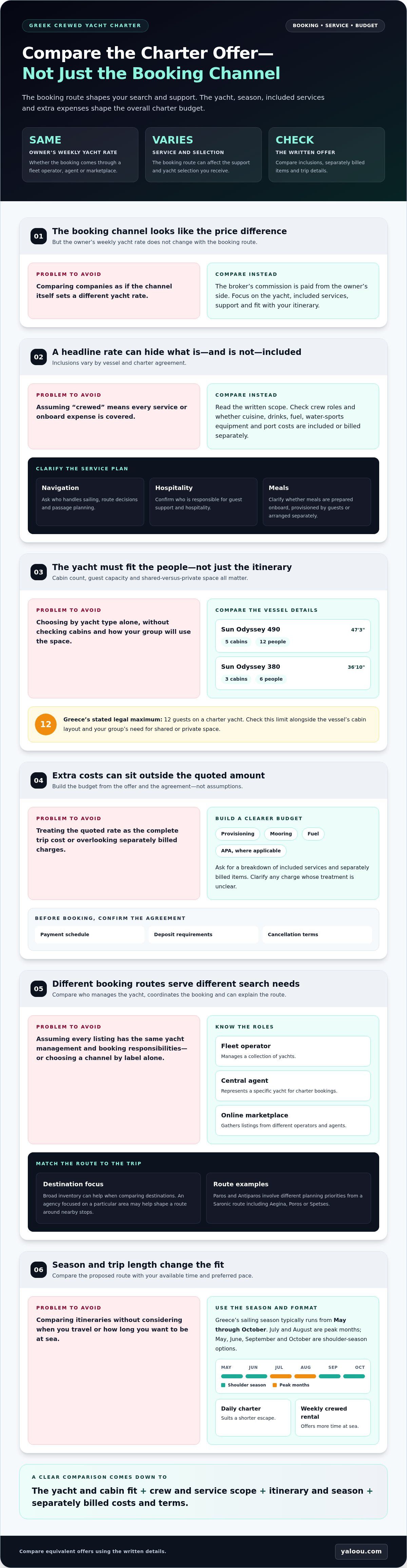
- The owner’s weekly yacht rate stays the same whichever company sends the booking; the booking route can affect the support and selection you receive.
- Build a realistic budget by accounting for extras such as provisioning, mooring, fuel and APA, where applicable.
- Before booking, understand the payment schedule, deposit requirements and cancellation terms in the charter agreement.
- Match the booking format to your trip: a daily charter suits a shorter escape, while a weekly crewed rental offers more time at sea.
Crewed yacht inclusions and service
A crewed charter pairs a yacht with onboard service, but inclusions vary by vessel and agreement. Compare the written offer with your group’s needs, preferred destinations and dining plans.
Crewed Charter Inclusions
Start with the crew roles listed in the offer and clarify what each role covers. A skipper may manage sailing and route decisions, while other crew members may focus on hospitality or meal preparation. Check whether cuisine, drinks, fuel, water sports equipment and port costs are included or billed separately.
Match the yacht to your party and the space you need. The Sun Odyssey 490 is 47'3", has 5 cabins and accommodates 12 people. The Sun Odyssey 380 is 36'10", has 3 cabins and accommodates 6 people. These examples show why cabin count and guest capacity matter alongside yacht type.
Greece’s stated legal maximum is 12 guests on a charter yacht. Use that limit alongside the vessel’s cabin layout when comparing options for a group. A yacht that accommodates your party may still have a different balance of shared and private space, so consider how your guests will use the cabins during the trip.
For a sailing holiday around Mykonos or Paros, share your preferred islands, pace and dining priorities before finalizing the itinerary. Clarify whether meals are prepared onboard, provisioned by guests or arranged separately. This helps set clear expectations for cuisine and service.
Crew, Safety, and Emergency Support
Crew experience, yacht safety, insurance and emergency support depend on the vessel and charter agreement. Before booking, review the crew’s documented experience, the safety information provided onboard, insurance responsibilities and the process for contacting assistance.
A skipper’s practical sailing experience can help you understand their background. Julian Blatchley worked as a charter and delivery skipper for six years. Ask how the skipper handles passage planning, weather decisions and guest briefings, so you understand the scope of onboard support.
On arrival, learn how the crew introduces the safety equipment and explains its use. Establish how to raise a concern and how the crew communicates if plans change. Read the agreement to understand onboard responsibilities, how to contact assistance and how yacht insurance differs from personal travel cover.
Compare the written service scope with your group’s priorities. Identify who handles navigation, hospitality and meal service, then choose a crew arrangement that fits your plans for the Greek islands.
A forum participant advises checking what a Greek yacht charter quote includes, since additional unavoidable charges may apply. Ask for a breakdown of included services and separately billed items, and clarify any charge whose treatment is unclear.
Review these costs alongside crew duties, meals, fuel and port charges to compare the package with your group’s priorities. Keep the agreed scope clear: what the quoted amount covers and which unavoidable charges remain outside it. Written details help prevent assumptions about service and costs.
Greek fleet operators, central agents, and online marketplaces
The booking route affects how you search and who coordinates the charter, not the owner’s weekly yacht rate. Match the business model to your yacht type, itinerary and preferred Greek islands, such as Paros or the Saronic destinations near Athens.
Greek Charter Business Models
A fleet operator manages a collection of yachts, while a central agent represents a specific yacht for charter bookings. An online marketplace gathers listings from different operators and agents. For crewed charters, the owner’s weekly yacht rate is the same whichever company sends the booking; the broker’s commission is paid from that rate on the owner’s side.
For bareboat and skipper-only sailing boat charters, fleet operators or marketplaces are the recommended booking route rather than a brokerage house. Compare who controls the vessel, handles the booking and can explain the itinerary. These roles can differ even when two listings show the same yacht.
Greece offers a wide choice of islands and departure points. A broad inventory can help when comparing destinations, while an agency focused on a particular area may help shape a route around nearby stops. A trip through Paros and Antiparos, for example, calls for different planning priorities from a Saronic itinerary that includes Aegina, Poros or Spetses. Choose the booking channel that fits your intended route.
Boutique Greek Sailing Agencies
When considering a boutique agency, focus on the service around the booking: how it matches a yacht to your group, explains the crew’s role and develops a route. The boutique label alone does not establish what is included. Compare the actual proposal, including the yacht, crew, itinerary and onboard services.
Named Greek agencies can’t be reliably identified from the available verified facts, so avoid treating a general category as a vetted shortlist. Instead, assess each offer using concrete criteria: is it crewed, does its route fit your preferred destinations, and does the agency explain who manages the yacht?
Season also shapes your options. Greece’s sailing season typically runs from May through October. July and August are peak months, while May, June, September and October are shoulder-season options. The Saronic Islands suit first-time charterers seeking proximity to Athens and relatively easy line-of-sight navigation. For a September trip, compare the proposed route with your available time and preferred pace.
The Moorings crewed yacht charter versus boutique Greek sailing agencies comparison is most useful when it focuses on service and fit, not assumed rate differences. For a shorter escape, explore private yacht experiences as another way to plan time on the water.
Additional charter expenses
The base charter rate is only one part of a Greek sailing budget. Provisioning, fuel, mooring, damage protection, transfers and activities can add separate costs. Make a list of written inclusions, then distinguish predictable expenses from spending that may change during the trip. A route around Paros and Antiparos, for example, may involve different stops and berthing choices from an itinerary based near Athens.
Provisioning depends on your group’s meal plan, dietary needs and time aboard. List groceries, drinks and meals ashore separately. If you want a private chef, clarify how food purchases are handled and whether they are separate from the service. This keeps cuisine costs distinct from the charter package.
Fuel use depends on the yacht type and route. A motor yacht covering longer distances uses fuel differently from a sailing yacht following a shorter itinerary. In the Cyclades, allow flexibility for weather and sailing conditions when planning daily passages. The route, time under power and distance between destinations all affect fuel consumption. A plan that includes several islands may therefore have different operational needs from one focused on nearby bays.
Mooring costs vary by location, yacht type and length of stay. Some Greek marinas may add a 50-80% supplementary mooring fee for catamarans. Include overnight berthing as its own budget line, and distinguish marina stops from anchoring. Stops near popular ports or ancient sites can influence where you berth.
Season can shape both availability and spending choices. Greece’s sailing season typically runs from May through October, with July and August as peak months. September falls within the shoulder season. Set your dates before comparing routes, since the same destination plan can involve different stops and operational needs across the season.
- Bareboat charter: Greece requires a sailing license, and the SLC and ICC are widely accepted. A skipper is a separate planning item when guests don’t sail themselves.
- Review the policy terms and guest responsibilities.
- APA: For Greek catamaran charters, the advance provisioning allowance is estimated at 20% to 30% of the base rate. It covers onboard operating expenses rather than the charter fee itself.
For a practical estimate, list the yacht, dates, route, guest count, provisioning plan and likely mooring stops. These choices determine how additional expenses add to the charter. A clear breakdown makes it easier to compare itineraries and plan a Greek sailing holiday with fewer budget surprises.
Which Greek boutique sailing agencies offer crewed yacht charters?
Choose a Greek charter agency based on the service it arranges, the yacht it represents and the route it can plan. For a crewed charter, consider whether the agency can match your group with a yacht and crew, then coordinate the itinerary and onboard service. A boutique label alone does not tell you those details.
Start with the kind of trip you want. A crewed charter suits guests who want a skipper to handle sailing and route decisions, rather than operating a bareboat charter themselves. Then define your group size, preferred destinations and onboard priorities. A couple seeking quiet island stops has different needs from a family wanting several cabins and a relaxed pace.
Use yacht specifications to make the request concrete. The Sun Odyssey 490 measures 47'3", has 5 cabins and accommodates 12 people. The Sun Odyssey 380 measures 36'10", has 3 cabins and accommodates 6 people. These examples help frame the space and capacity you need. Ask the agency to match the vessel’s layout and crew arrangement to your party, rather than relying on broad descriptions such as “spacious.”
Next, assess the agency’s destination knowledge against a real itinerary. The Saronic Islands suit first-time charterers seeking proximity to Athens and relatively easy line-of-sight navigation. A Cyclades route has different considerations. Starting from an island such as Paros can reduce time spent travelling from the mainland toward the islands you want to visit. For an Ionian route, agencies providing regional coverage across these waters can be a useful point of reference in the discussion.
Season changes the choices. Greece’s sailing season typically runs from May through October. July and August are peak months, while May, June, September and October are shoulder-season options. Share your preferred dates and route priorities together. A September proposal should reflect your actual island choices and pace, not simply reuse a high-season itinerary.
Before comparing agencies, request the same essentials in each proposal: yacht model, cabin layout, crew roles, departure base, itinerary, included services and extra-cost categories. Then compare how clearly each explains the trip. A crewed charter should specify who handles navigation and what hospitality is arranged. For meals, distinguish onboard service from provisioning and any additional chef arrangements.
There isn’t a verified named shortlist to present here, so use these criteria to assess the specific Greek agencies you’re considering, including specialists such as YAL’OOU Exclusive Yachting & More. The Moorings crewed yacht charter versus boutique Greek sailing agencies comparison is most useful when the offers are matched by vessel, dates, route and service, not by brand label alone.
What are the booking, deposit, cancellation, and payment terms for Moorings and Greek agencies?
Booking terms cannot be compared by company name alone. The signed charter agreement sets the deposit schedule, balance due date, cancellation consequences and payment process for each reservation. For a Moorings charter or a Greek agency booking, compare the same details before paying. Do not assume identical deposit percentages, deadlines or cancellation penalties across bookings.
Use the agreement as a four-part checklist. First, identify what makes the booking binding, such as an accepted offer and signed contract. Second, locate each payment due date and the amount or share due then. Third, read what happens if the guest cancels, including refund rules and deadlines. Fourth, find the procedure for changes to dates, guests or itinerary. This sequence keeps essential obligations clear.
Pay particular attention to deposits. Record the amount due at booking, the date of any later instalment and the final balance deadline in one calendar entry. Check whether the contract describes payments as refundable, partly refundable or non-refundable under specified conditions. Those terms determine the financial impact of cancellation. Read the payment schedule alongside the cancellation clause, not as a standalone summary.
Compare cancellation terms by scenario, not by headline wording. A guest-initiated cancellation may be treated differently from a date change or a disruption affecting the charter. Read the contract’s stated triggers, notice requirements and refund calculation. If a clause uses defined terms, follow those definitions through the document. For example, check whether “booking date” means the payment date or contract acceptance date.
Payment logistics matter, too. Note the accepted payment method, currency, any bank-transfer instructions and who receives each instalment. Match the beneficiary name to the contracting party named in the agreement. Keep the invoice, signed contract and payment confirmations together. This creates a clear record if you need to review the booking details or payment history.
For a fair Moorings-versus-Greek-agency comparison, use a simple table with one row for each item:
- Booking: required documents and the point when the reservation becomes binding.
- Deposit: amount, due date and refund conditions.
- Balance: remaining payment deadline and accepted methods.
- Cancellation: notice process, applicable terms and any refund calculation.
- Changes: how date, guest or itinerary amendments are handled.
Save the final agreement and every payment receipt in the same booking folder. Then compare the clauses, not assumptions about whether a large operator or boutique agency uses more flexible terms. For a separate way to shape time on the water, explore private yacht experiences.
YAL’OOU Exclusive Yachting & More: Daily Yacht Charters
YAL’OOU offers Daily Yacht Charters for guests who want to experience Greece from the water without planning a week-long sailing itinerary. Choose this for a focused day at sea, or consider Weekly Crewed Yacht Rentals when you want more time to explore. High-End Villa Rentals and VIP Ground Transfers can complement a wider Greek getaway.
Think about the shape of your trip first: a day aboard suits a shorter escape, while a weekly crewed charter gives your group a longer sailing experience. Pair the yacht with a villa stay or ground transfers if those fit your plans. Each element supports a different part of the journey, without requiring one booking format for every travel need.
Explore the options that fit your itinerary, or visit yaloou.com to get in touch with YAL’OOU Exclusive Yachting & More.
Shape Your Greek Sailing Experience
Turn your preferred style of travel into a personal Greek escape. Decide whether you want a day on the water, a longer yacht stay or a trip that combines time at sea with a villa. Your Moorings crewed yacht charter versus boutique Greek sailing agencies comparison can clarify the booking route, but the right choice also depends on how you want each day to unfold.
YAL’OOU Exclusive Yachting & More offers Daily Yacht Charters, Weekly Crewed Yacht Rentals and High-End Villa Rentals. These options let you plan around the experience you want, whether that means a focused day at sea or a wider island getaway. Choose the format that suits your plans, then take the next step at your own pace.
Explore yacht experiences with YAL’OOU Exclusive Yachting & More and start shaping a Greek escape that feels like yours.
Frequently Asked Questions
How much does it cost to charter a yacht in Greece?
There’s no single cost for a Greek yacht charter: the total depends on the yacht, dates, trip length, crew arrangement and included services. To compare options, use the same guest count and travel dates, then separate the charter rate from provisioning, fuel, mooring and other extras. A day charter and a week-long crewed trip are different formats, so compare each against the experience you want.
Does the price change with the company you book through?
For a crewed charter, the owner’s weekly yacht rate is the same regardless of which company sends the booking; the owner’s side pays the broker’s commission from that rate. The booking channel can still shape the listings and support you receive. Compare equivalent yachts, dates, crew services and inclusions. For example, a quote for Mykonos may describe a different itinerary and onboard arrangement from one for Paros.
How do you check a Greek charter company before you wire a deposit?
Before sending a deposit, match the contract, invoice and payment instructions. Confirm that they name the same contracting party, yacht, dates and charter arrangement. Read the deposit schedule, cancellation terms and refund conditions, then ensure the payment beneficiary matches the named party. Keep signed documents and payment records together. If the itinerary includes several Greek islands, make sure the agreed route and included services are clearly stated in the booking documents.
Disclaimer
The YAL’OOU Travel Guide is curated with care to inspire and inform discerning travelers. While every effort is made to ensure the accuracy and relevance of the information provided, all content is offered for general guidance only and may evolve over time.
Details such as local regulations, availability, pricing, and services are subject to change without prior notice. We encourage guests to seek personalized advice and confirm arrangements directly when planning their journeys.
YAL’OOU accepts no liability for any inaccuracies, omissions, or outcomes arising from the use of this information. The Travel Guide may feature recommendations, insights, and selected third-party experiences, presented solely as a source of inspiration and not as formal endorsements.
By accessing this section of our website, you acknowledge and accept this disclaimer as part of your experience with YAL’OOU.